
Why Asia Will Lead Global Football Talent in 2026
In 2025, Asia becomes a key global talent source. Japan, Korea, China, Indonesia and Uzbekistan are producing disciplined, “European-ready” players.
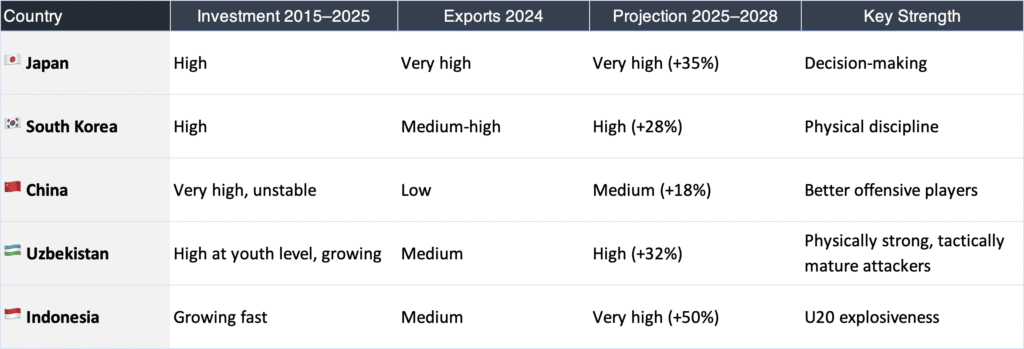
The rise of Asian football is measurable, consistent, and strategically significant. Investment has multiplied, development structures have matured, and a new generation of players is emerging with the tactical understanding, discipline and mentality required to thrive in Europe.
The question is no longer whether Asia will become a global talent supplier. The real question is whether your club will enter early enough—before the opportunity window closes.
1. Investment, Development, and Exportation Trends
The evidence from the last decade is clear:
- —Japan: academy investment x2.3 since 2015; 70+ players exported to Europe in 2024 (historic record).
- —South Korea: more than 120 certified high-performance centers; U23 exports have grown 26% annually since 2020.
- —China: over USD 3 billion invested in infrastructure (2015–2023); U20 talent volume increasing.
- —Uzbekistan: Their U20 and U23 teams are among the strongest in Asia.
- —Indonesia: long-term development plan (2024–2034), booming private academies, and a population of 280M with an average age of 29.
2. The Tactical Leap: A More Mature Player Profile
Asian players today are fundamentally different from those of five years ago. They understand the game, interpret space, and adapt quickly to complex systems.
- —Japan produces players skilled in positional play (3-2-5, 4-3-3) with elite decision-making.
- —South Korea develops high-level physical-tactical profiles: dynamic midfielders, aggressive centre-backs, vertical full-backs.
- —China is generating technical interiors and young defenders with strong projection.
- —Uzbekistan: physically strong, tactically disciplined and one of the most “European-ready” U23 profiles in Asia.
- —Indonesia is producing explosive wingers, creative midfielders, and U20 players ready for rapid growth.
3. Europe Has Already Reacted: The Scouting Shift
The behaviour of European clubs confirms the trend:
- —More than 30 European clubs have established direct scouting pipelines in Japan and Korea.
- —Portugal, Belgium, Denmark and Scotland have doubled their Asian signings since 2019.
- —LaLiga, Serie A and Ligue 1 clubs now send full-time scouts to Asian university and U18 competitions.
- —Indonesia is beginning to produce regular U20 transfers to Europe.
- —China is placing young players in Spain and Portugal as part of development pathways.
4. Comparative Outlook 2025: Where Will the Talent Come From?

5. EFC Insights by Country (Exclusive Professional Value)
🇯🇵 Japan
University players are now tactically more mature than many European U21 academy players.
🇰🇷 South Korea
Central defenders and midfielders are undervalued by 30–40% compared to their real performance level.
🇨🇳 China
Exportable talent is concentrated in 5–8 elite academies.
🇺🇿 Uzbekistan
One of the most undervalued markets in Asia. Generation with physical power, tactical maturity and strong mentality.
🇮🇩 Indonesia
Wingers and attacking U20 profiles identified today will generate exponential value within 18–24 months.
6. Early Signals: Identifying Future Internationals
- —Consistent performances in AFC U18/U20 tournaments
- —Tactical command in 4-3-3 / 3-2-5 structures
- —High Competitive Stability
- —Early exposure to foreign coaches
- —High-pressure match minutes (derbies, finals)
Conclusion: The Window Is Open — But Not for Long
Europe no longer competes with South America alone. Its new competitor is Asia.
And the opportunity window will close before 2028. Clubs that move now will dominate the 2025–2030 cycle.
Related Articles

March 8, 2026
The Asian Football Market: A Recruitment Advantage
Over the past fifteen years, many European clubs have looked at Asia primarily as a commercial opportunity. Preseason tours. Regional sponsors. Fanbase expansion. But while many clubs saw marketing, others began to see something far more...
Read Analysis
February 13, 2026
Indonesia Football Market 2026: Talent Acceleration and Structural Risk Management
Indonesia isn’t just growing, it’s repositioning itself competitively and strategically within Asian football. What we are seeing today is the result of deliberate, highpace changes post2022 that seek to elevate performance, credibility, and market...
Read Analysis
February 3, 2026
AFC U23 Asian Cup: Structure, Decision-Making and Market Insight
Japan confirms its model, China advances through process, Korea sustains intensity The recently concluded AFC U23 Asian Cup delivers a clear message to clubs, sporting directors and scouting departments: Asian U23 football is now less predictable,...
Read Analysis