
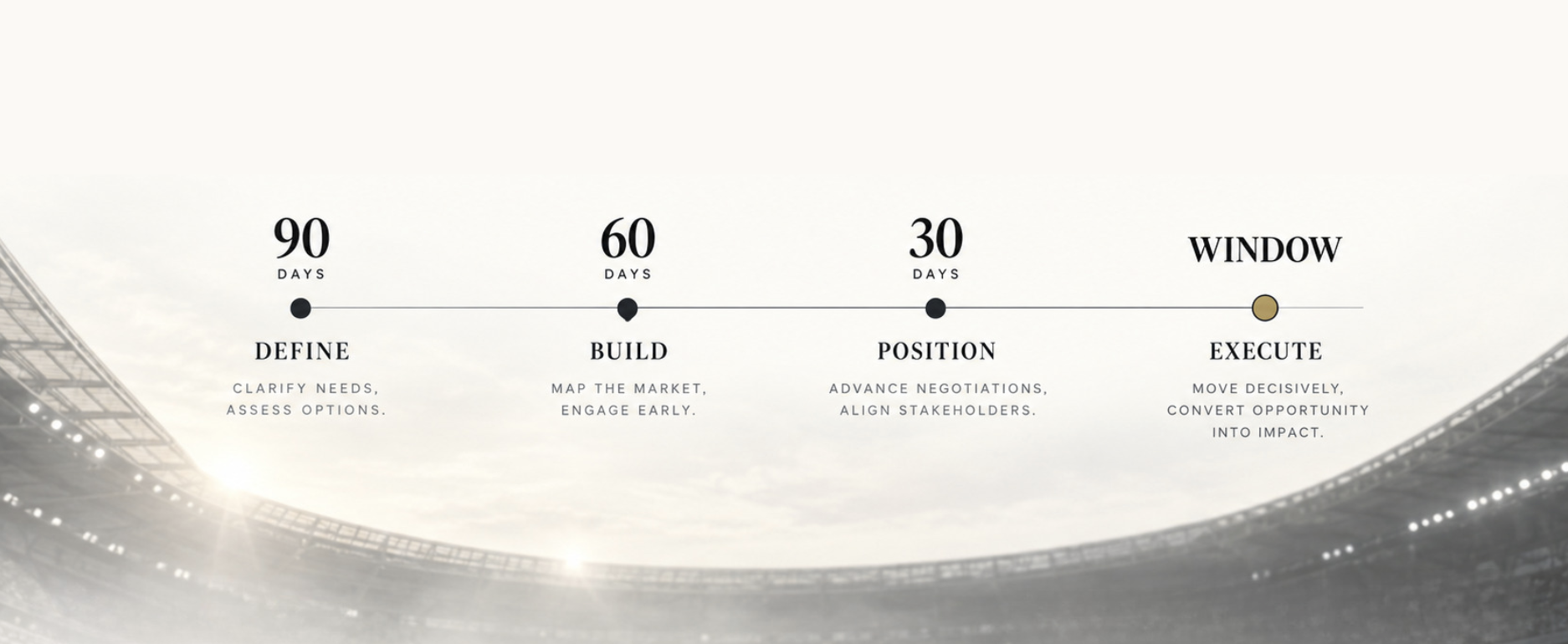
How clubs operating in China, South Korea and Japan can build better recruitment positions before the market becomes urgent
For clubs operating across Asian football, the next transfer cycle does not begin when player registration officially opens.
It begins months earlier.
China, South Korea and Japan are three of Asia's most important professional football markets, but they do not operate under the same recruitment logic. Their calendars, regulatory environments, salary structures, foreign-player dynamics and negotiation cultures are different.
What they do share is one operational reality:
Once the market becomes active, the cost of making decisions increases.
Players begin receiving multiple approaches. Agents test demand across different countries. Salary expectations move. Clubs reassess availability. Coaching changes alter recruitment priorities. And time increasingly becomes part of the negotiation.
For clubs entering these markets without a defined recruitment position, the window quickly becomes reactive.
For clubs that prepare earlier, the window becomes an execution period.
The next Asian transfer window is not a January problem. It is a September, October and November preparation problem.
90 Days: Understand the Squad Before Entering the Market
The first decision is not which player to sign.
It is what problem the club needs the market to solve.
This becomes especially important in Asian football because the value of a foreign recruitment slot can extend beyond the individual player.
A club may need a striker, but that description alone is insufficient.
Does the team need a reference No.9 or a forward capable of attacking space?
Does the player need previous Asian experience?
What level of physicality does the league demand?
What salary range is realistic in that specific market?
Is the club recruiting for immediate impact or future value?
What happens if an expected departure does not occur?
Before identifying names, the club should review its squad, contracts, expected departures, tactical requirements, domestic-player structure and available financial resources.
The answer will not necessarily be the same in China, South Korea or Japan.
That is precisely why recruitment should begin with the club context rather than with the player market.
90 DAYS → RECRUITMENT BRIEF
A clear definition of the sporting problem, market parameters and profile required.
60 Days: Build the Relevant Asian Market
Once the requirement is clear, attention moves towards the market.
This is where international recruitment can become inefficient very quickly.
A club looking for a foreign striker in Asia can potentially receive dozens — sometimes hundreds — of player proposals from Europe, South America, Africa and other Asian leagues.
Access is not the problem.
Filtering is.
The recruitment process should progressively reduce that universe according to:
- tactical fit;
- competitive level;
- age;
- contractual position;
- salary expectations;
- transfer fee;
- availability;
- international experience;
- adaptation risk;
- transferability to the destination league.
A player suitable for the K League is not automatically suitable for the Chinese Super League.
A player capable of succeeding in China may not provide the same value in Japan.
And a strong European CV does not automatically translate into performance in any of them.
This is why the objective should not be to produce a large shortlist.
It should be to identify a limited group of decision-ready options.
By this stage, every priority position should begin moving towards a Plan A / Plan B / Plan C structure.
60 DAYS → DECISION-READY SHORTLIST
Relevant players who fit both the football requirement and the realities of the destination market.
30 Days: Understand What Is Actually Executable
A shortlist is only useful if the operations behind it are realistic.
Thirty days before an active recruitment period, the question changes from:
Which players fit?
to:
Which deals can actually be executed?
This means testing the market.
Is the player genuinely available?
What does the current club expect?
What salary does the player expect in Asia?
Are there competing offers from the Gulf, Europe or other Asian leagues?
What role does the player expect?
How complex is the contractual situation?
What adaptation risks should influence the structure of the deal?
The Asian market creates an additional challenge: reliable financial and operational benchmarks are not equally transparent across countries.
Local context therefore matters.
A club negotiating without its own understanding of value can easily allow an agent, selling club or competing market to establish the economic reference for the operation.
By this point, the club should know both its preferred target and the conditions under which it should move to the next option.
30 DAYS → NEGOTIATION POSITION
Preferred players, realistic financial parameters, alternatives and clearly defined limits.
China, South Korea and Japan Require Different Recruitment Logic
Treating “Asia” as one transfer market is a mistake.
South Korea
K League recruitment combines a competitive domestic environment with an increasingly international player market.
The market begins moving before registration officially opens, with clubs assessing foreign-player needs, contract situations and available options well in advance.
For clubs operating in Korea, preparation means understanding not only player quality, but also role fit, salary expectations, availability and the specific demands of the K League.
China
China operates under a different recruitment context.
The end of the domestic season creates a natural point for squad review, foreign-player evaluation and preparation for the next registration period.
Regulation, financial parameters and timing remain central parts of the recruitment process.
For clubs and players considering China, the opportunity is not simply created when the window opens.
It is created when needs become identifiable and market competition is still limited.
Japan
Japan requires another logic again.
The evolution of the J.League calendar changes the timing of squad planning and recruitment decisions.
Japan also operates with a different football culture, negotiation environment and player-development structure from China and South Korea.
Three major Asian markets. Three different recruitment environments. One recruitment methodology cannot ignore those differences.
When the Window Opens: Execute, Don't Discover
Market pressure cannot be removed.
Another club may enter the negotiation.
A target may disappear.
An injury may suddenly create another priority.
A manager may request a different profile.
An unexpected player may become available.
The purpose of preparation is not to eliminate those events.
It is to prevent them from taking control of the recruitment process.
A prepared club can compare every new opportunity with an established recruitment brief, evaluated alternatives and predefined financial parameters.
An unprepared club eventually reaches the most dangerous question in a transfer window:
Who is available?
At that point, availability begins to replace suitability.
And the club is no longer directing the market.
It is reacting to it.
The Opportunity in Asia Starts Before the Window
China, South Korea and Japan continue to offer opportunities for clubs, players, agents and football organisations operating across international markets.
But opportunity is not simply created when a registration window opens.
It is created earlier — when needs become visible, contracts approach expiry, clubs begin planning squad changes and the market has not yet reached maximum pressure.
That is where preparation matters.
90 DAYS → RECRUITMENT BRIEF
60 DAYS → DECISION-READY SHORTLIST
30 DAYS → NEGOTIATION POSITION
WINDOW → EXECUTION
The visible transfer happens at the end of that process.
The competitive advantage is built before it.
In Asian football, the best transfer opportunities are rarely discovered when everyone is already looking.
EFC · Football Advisory
Elite Football Consultancy supports clubs and football organisations operating across China, Japan, South Korea and Southeast Asia, combining Squad Planning, Player Assessment and Transfer Market Advisory with direct knowledge of Asian football markets.
Preparing for the next Asian transfer cycle?
Discuss an opportunity with EFC.
